Outdoor Patio Lighting Design: Planning Layouts for Summer Entertaining and Year-Round Use
.jpg)
A patio that earns its keep three hundred and sixty-five days a year doesn't get strung up for a July barbecue and forgotten by September. It pulls people outside for coffee in October, holds a crowd around a fire pit in January, and still feels like the best seat in the house come next summer.
That kind of patio happens because someone planned the layout before a single fixture went in the ground. Zones get mapped first. Light shifts in mood from sunrise to last call. The whole system flexes to carry a twelve-person cookout one night and a peaceful solo morning the next.
I'm Bill Frey, President of Illuminating Design Inc. Over 20 years of designing and installing outdoor lighting across metro Atlanta, I've watched this play out on property after property.
The patios that get used every single month of the year are never the ones lit for a moment. They're the ones lit for a life. The rest of this guide breaks down exactly how that layout gets built, zone by zone, season by season.
Start With How You Use the Patio
Before any fixture gets chosen, the patio needs a use case.
Most lighting plans get built around the busiest version of the space, the night with twelve people and a grill going. That's a reasonable starting point, but it leaves out the patio on an ordinary Tuesday, the patio when only two people are home, the patio during the stretch of the year when nobody's hosting anything at all. A layout built around one scenario tends to fall short the moment the use case shifts.
Walk the patio at dusk and ask a few questions before drawing up any plan:
- Where do people sit when it's just two people, versus when there's a crowd?
- Does anyone use this space before 9 a.m., and if so, does it need real light or just enough definition to feel intentional?
- Is there a fire pit, grill, dining set, or quiet corner that pulls people toward a specific spot?
- Which zones get used together, and which ones operate independently of each other?
These answers shape everything that follows:
- A patio built mainly for evening entertaining calls for a different ambient layer than one that doubles as a morning retreat.
- A patio with a defined dining zone and a separate lounge zone benefits from lighting that distinguishes between the two, rather than one wash of brightness covering both.
- A patio used across seasons benefits from a layout flexible enough to shift from one kind of gathering to another without a full redesign.
This mapping is what turns a lighting plan from decorative into genuinely useful. Once the use cases are clear, the three-layer lighting system that follows has something solid to build around.
.jpg)
The Three-Layer Approach to Outdoor Patio Lighting Design
The next step is building light in layers rather than relying on one source to do every job. Three layers cover the full range a patio needs: ambient, task, and accent.
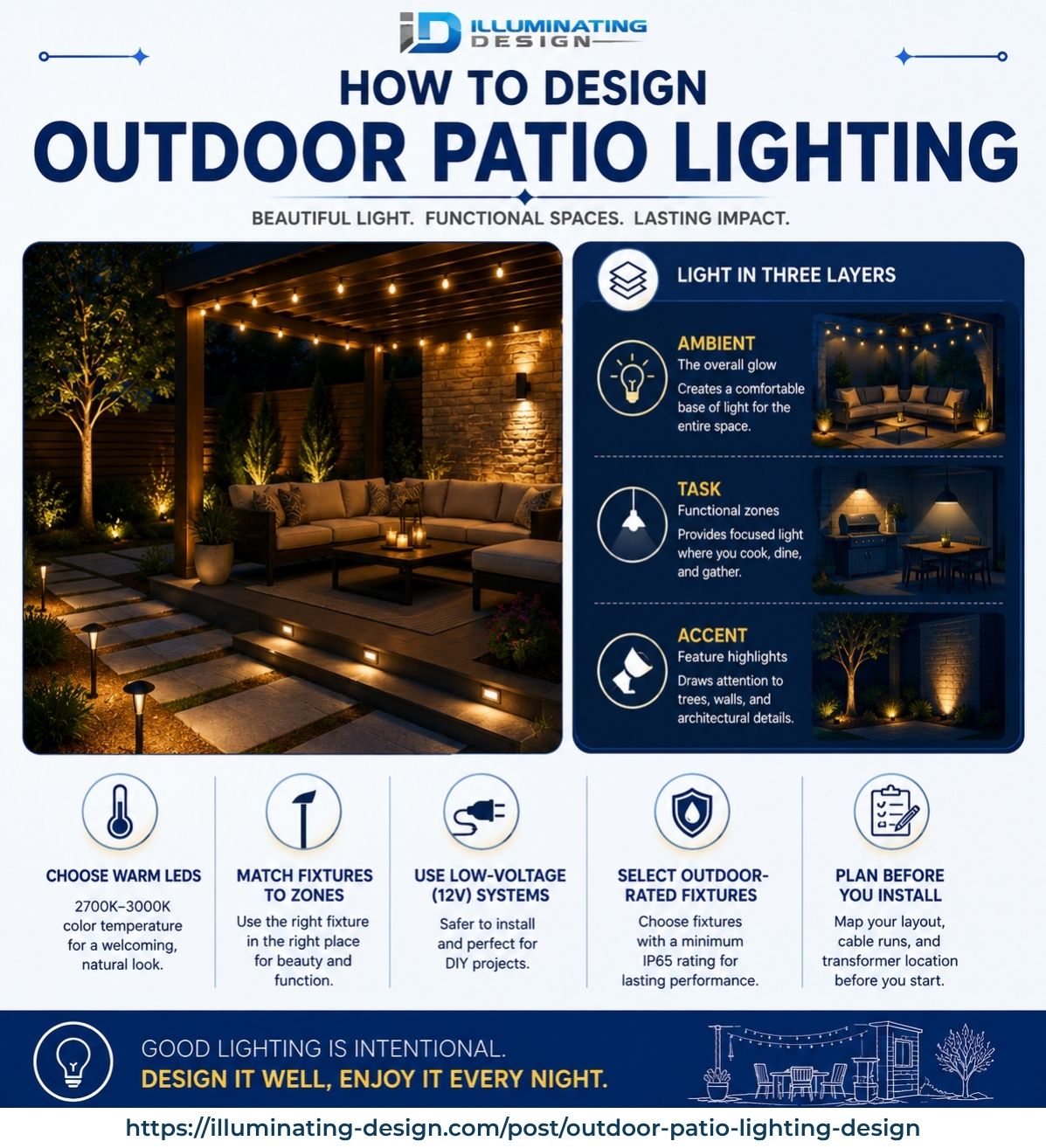
Ambient Lighting (The Foundation)
This is the general glow that lets people move through the space safely without anything feeling glaring or clinical. Instead of one bright floodlight, ambient light gets distributed across several softer sources including wall-mounted sconces, low-voltage post lights, or permanent trim lighting along the roofline.
Spreading the light this way avoids the harsh, single-source shadow that makes a patio feel flat the moment the sun goes down.
Task Lighting (The Functional Layer)
Task lighting covers the spots where something specific is happening: a grill station, a dining table, a set of steps. A grill bench benefits from focused downlighting of at least 300 lumens so the cook isn't working blind.
Steps and any change in elevation call for low-voltage step lights, both for visibility and for safety. This layer exists to make the patio usable, not just visible.
Accent Lighting (The Dramatic Layer)
Accent lighting is where a patio goes from lit to designed. Well lights at the base of a mature tree, uplights angled onto a textured stone wall, a soft wash highlighting a planting bed along the perimeter: these draw the eye outward and make the whole yard feel larger and more finished after dark.
Each layer covers a different job, so none of them needs to overcompensate for the other two. A patio with strong ambient light but no accent layer feels safe but flat. A patio with dramatic accent lighting and no task layer looks great in photos and is hard to actually cook or dine in. Combining all three is what makes a patio read as one cohesive space rather than a collection of bright spots and dark gaps.
This three-layer foundation applies no matter what the patio gets used for. What changes from here is where each layer gets placed, which is exactly what the next section breaks down for summer entertaining specifically.
Layout Zones for Summer Entertaining
Summer is when a patio gets asked to do the most. A dinner party, a casual hangout by the fire pit, a cookout that spills across the whole yard: each of these needs its own zone, and each zone needs its own lighting approach pulled from the three-layer system above.
Dining Zone
A dining table is where task lighting matters most. A pendant or hanging fixture centered over the table gives guests enough light to actually see their food without glare in anyone's eyes.
Candlelight works well here too, doing double duty as both task light and atmosphere. The goal is enough brightness to make the table feel anchored, without spilling so much light that it washes out the rest of the patio.
Lounge or Conversation Zone
This is where ambient light should feel softest. String lights overhead, a few well-placed lanterns, or a low-voltage sconce near the seating area all keep the mood relaxed rather than bright. People linger longer in a space that feels dim enough to be cozy but lit enough to read a face across the circle.
Perimeter or Fire Pit Zone
On larger patios, the edges need their own definition, especially if a fire pit anchors one corner. Torchlights along the perimeter mark the boundary of the space and, as a bonus, help keep bugs away during the warmer months.
Uplighting on a nearby tree or wall extends the accent layer outward, making the whole yard feel like one continuous space instead of a patio with a dark edge.
Our guide on unique ways to light up the exterior of a property has more ideas for treating the perimeter as its own design feature.
Circulation Paths
Whatever zones exist, the paths connecting them need light too. A few path lights or low-level step lights between the dining area, the lounge area, and the fire pit keep guests moving safely without needing to squint their way across the yard.
This is a small detail that gets overlooked often, but it's the difference between a patio that flows and one where people bunch up near the one lit spot.
Mapping these zones individually is what makes a summer gathering feel intentional.
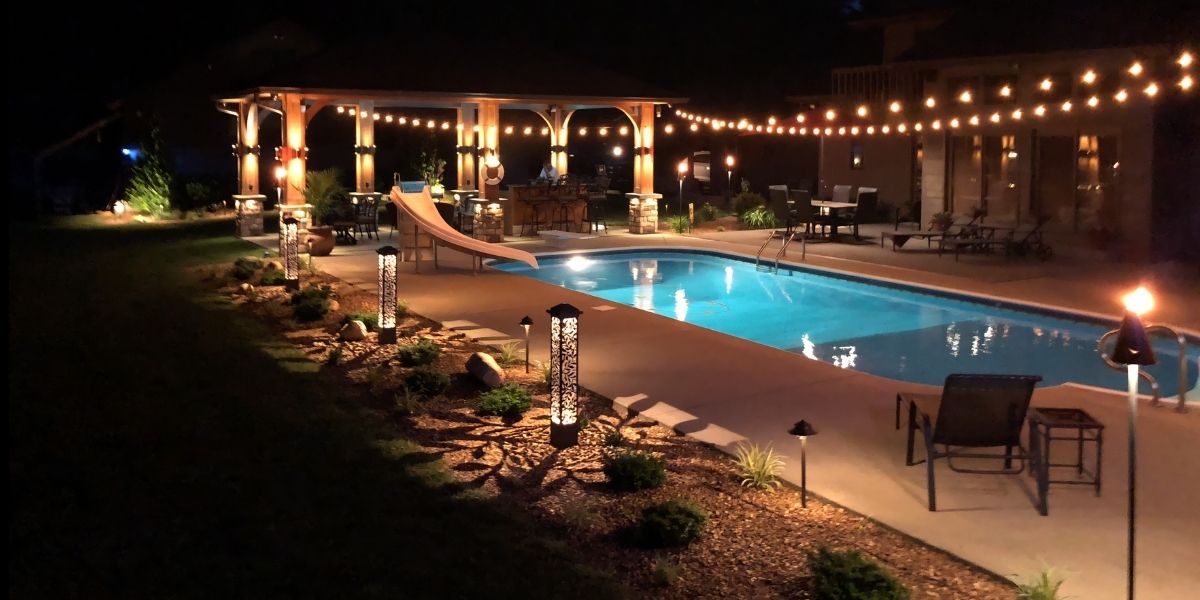
Designing the Same Patio for Morning, Midday, and Evening
A patio built for a dinner party doesn't automatically work for the rest of the day. The zones from the section above stay the same, but what each one needs from its lighting shifts depending on the hour.
Morning
Natural light does most of the work here, so the patio rarely needs artificial lighting turned on at all. What matters more is that fixtures stay unobtrusive in daylight, sconces and post lights that look intentional rather than clunky when they're off.
A patio meant for a quiet coffee before work benefits from a dining or lounge zone that feels calm and uncluttered, not one dominated by hardware that only earns its place after dark.
Midday
This is when a patio tends to get used for everything except lighting: lunch outside, kids moving in and out, someone working from a laptop at the table. The zones from summer entertaining still apply, but the priority shifts to function over mood.
A grill station or dining area that's well-placed during the day will already be in the right spot when task lighting takes over in the evening, so there's no need to redesign the layout twice.
Evening
This is where all three layers come together the way they're designed to. Ambient light fills in as the sky darkens, task lighting switches on for cooking and dining, and accent lighting starts pulling focus toward the trees, walls, and perimeter that disappear once it's fully dark.
The same dining zone that hosted lunch now hosts dinner under a different kind of light entirely.
Because the zones don't change from morning to night, the layout doesn't need to be rebuilt as the day moves.
What changes is which layer takes the lead: ambient and unobtrusive in the morning, functional at midday, fully layered by evening. That same logic carries forward across the calendar too, which is where seasonal adjustments come in next.
Adjusting the Layout Across Seasons
The zones and layers stay fixed. What shifts with the seasons is how much each layer gets asked to do.
Summer
Daylight lasts longer, so the lighting system carries less of the evening on its own. Torchlights and perimeter accents matter more here, both for the mood and for keeping bugs off the patio during peak season.
Ambient light can stay on the softer side since guests are often still arriving while there's natural light left in the sky.
Fall and Winter
Shorter days mean the lighting system starts earlier and works harder. A fire pit zone becomes the anchor for most gatherings, and the lighting around it should support that, gentle accent lighting nearby rather than anything that competes with the flames.
Ambient lighting also needs to step up earlier in the evening to cover the hours that used to belong to daylight.
Year-Round
Weatherproofing is what makes any of this hold up across seasons without constant repairs. Fixtures rated for the local climate, whether that means humidity in the summer or cold and moisture in the winter, keep the system reliable instead of needing replacement parts every few months.
A layout that survives one full year of weather swings is a layout that was planned for the climate from the start, not adjusted after something failed.
This is also where the same zones from summer entertaining prove their value beyond a single season. A dining zone built for July dinners still works for a Thanksgiving gathering.
A fire pit zone built for cool fall nights becomes the centerpiece again come winter. The layout doesn't change. Only the balance between layers does.
Fixture Selection by Zone
With the zones mapped and the seasonal demands clear, the next decision is which fixtures actually go where. Different zones call for different hardware, and matching the fixture to the zone is what keeps the layout from feeling like a generic kit dropped onto the patio.
For a full sense of where these costs land, our Atlanta landscape lighting cost guide breaks down pricing by fixture type and project scope.
For high-end residential properties in metro Atlanta, solid brass or copper fixtures hold up best. They naturally patina over time and resist the kind of humidity that wears down cheaper materials within a couple of seasons.
- Low-Voltage Deck/Step Lights: Best for steps, deck posts, and retaining walls, providing safety and a subtle perimeter glow. Installation difficulty is moderate, since it requires routing low-voltage wire. Relative cost: moderate.
- Permanent Trim Lighting: Best for roofline and architectural lighting, delivering year-round ambient glow. Installation difficulty is high, requiring professional installation. Relative cost: premium.
- Recessed Hardscape Fixtures: Best for under-cap stone walls, steps, and outdoor kitchen counters. Installation difficulty is high and is best planned during construction. Relative cost: premium.
Dining and Task Zones
Pendant or hanging fixtures over a dining table, paired with recessed downlighting near a grill station, cover the task layer without overwhelming the space.
Lounge and Perimeter Zones
Low-voltage path lights, spaced 5 to 8 feet apart in a staggered pattern, light walkways without creating the harsh, evenly spaced look of a runway.
Adjustable uplights work well on trees and architectural columns near the lounge or perimeter zone, casting texture and shadow.
Steps and Elevation Changes
Recessed step lights placed every 3 to 4 feet provide the safety margin steps and pool decks need, especially in the fire pit and circulation zones where guests are moving in low light.
Bulb Specifications: Kelvin, CRI, and LED Efficiency
The fixtures matter, but the bulbs inside them decide how the whole patio actually looks once it's lit. Three specifications drive that outcome: color temperature, color rendering index, and LED efficiency.
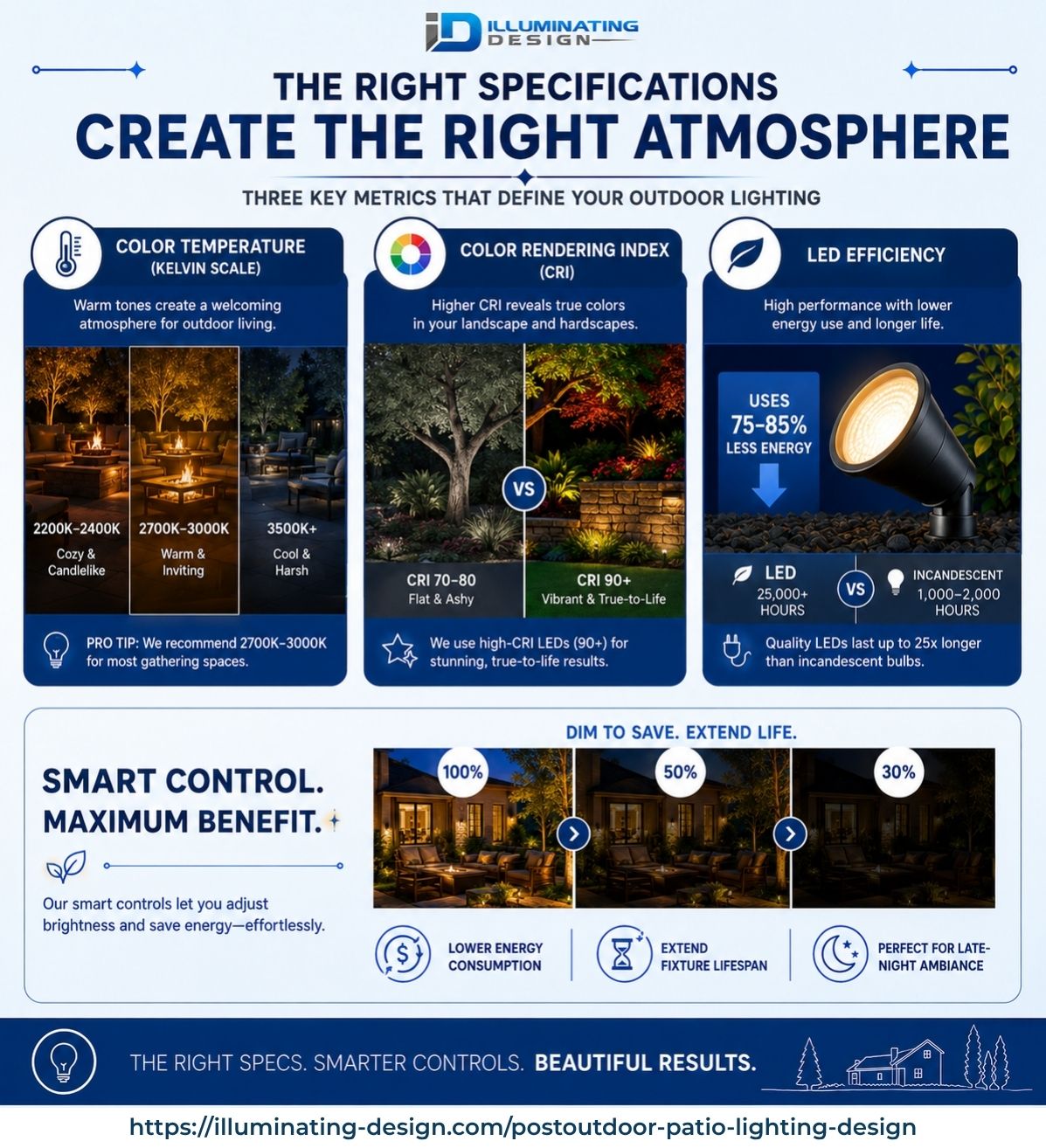
Color Temperature (Kelvin Scale)
Warm white tones work best for residential gathering spaces. Most outdoor fixtures land well in the 2700K to 3000K range. Tones closer to 2200K to 2400K read like candlelight, which suits a relaxed seating or lounge zone particularly well.
Anything above 3500K starts to feel clinical, more office parking lot than backyard.
Color Rendering Index (CRI)
CRI measures how accurately a light source reveals the true colors of whatever it's shining on, scored on a 100-point scale against natural daylight.
Cheaper LED bulbs often sit in the 70 to 80 range, which leaves plant foliage and stone looking flat and a little washed out. A CRI of 90 or higher keeps red maples, green lawns, and natural stone looking like themselves rather than a duller version of themselves after dark.
LED Efficiency and Heat Tolerance
Quality LEDs use roughly 75 to 85 percent less energy than incandescent bulbs and last considerably longer, 25,000-plus hours compared to the 1,000 to 2,000 hours typical of incandescent. That difference adds up fast across a system running multiple fixtures every night.
Bulb quality also shows up in how the system handles temperature swings, and outdoor bulbs deal with more of those than people expect.
A muggy 90-degree night in July and a cold front rolling through in January put real stress on a fixture, and cheaper LEDs tend to dim, flicker, or fail faster under that kind of repeated heat and cold cycling.
Well-built LEDs are designed to dissipate heat properly and stay stable across that range, which is part of why they hold their output and lifespan even on a patio that gets used in every season.
Smart controls make all of these specifications easier to manage over time. Dimming the system to 30 to 50 percent output late at night cuts energy use further and reduces heat buildup in the fixtures, which matters most in the zones, like ambient lighting along the perimeter, that tend to stay on the longest.
Getting these specs right is what separates a patio that looks intentional from one that just happens to have lights on it.
Planning and Installing Your Outdoor Patio Lighting System
A lighting plan only works once it gets installed correctly, and that part belongs with a licensed lighting professional. For more on why this isn't a DIY weekend project, see why professional lighting products outshine DIY options.
Once the zones, layers, and fixtures are decided, here's what an outdoor professional installation actually involves.
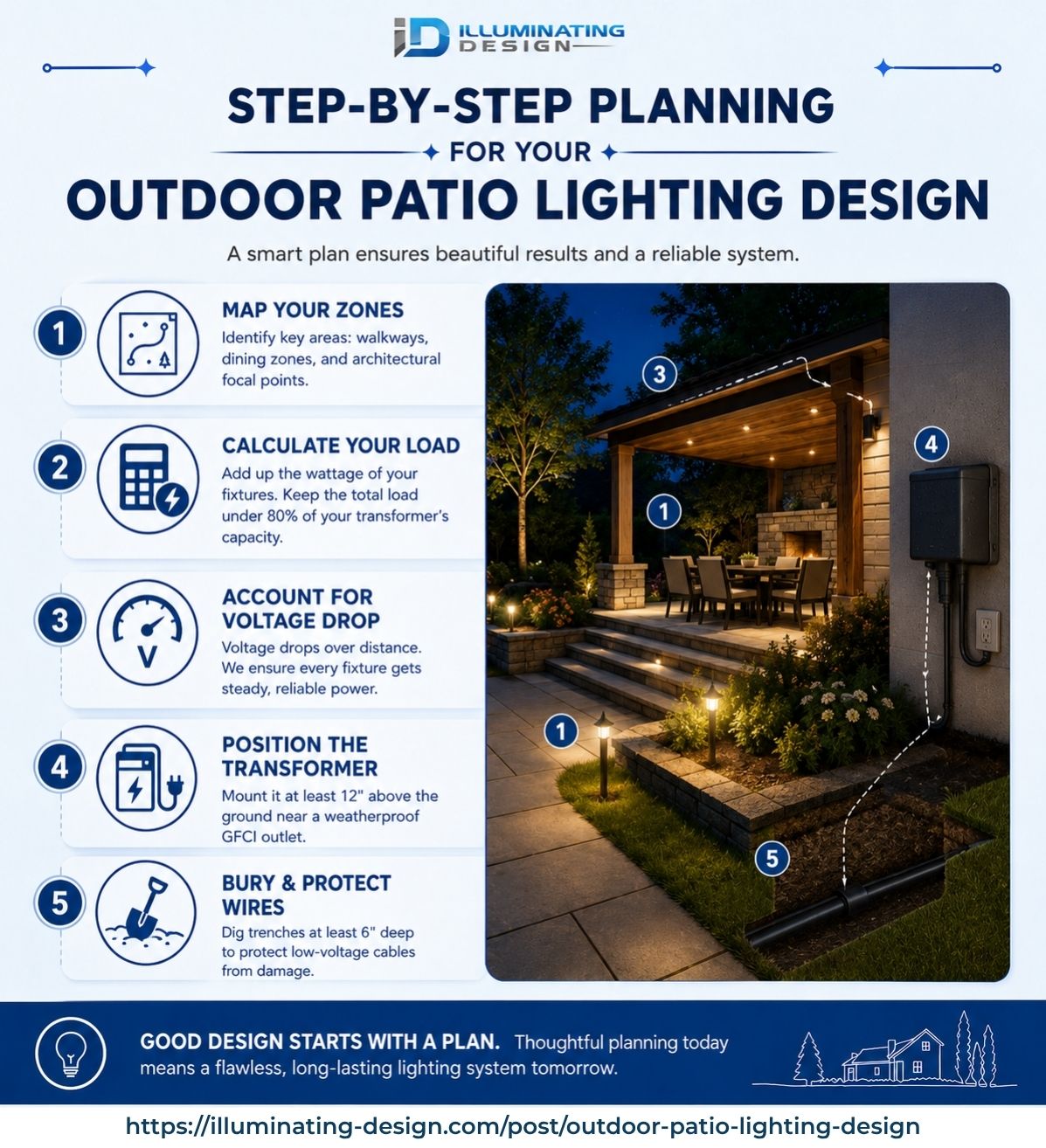
Mapping the Zones
The dining, lounge, perimeter, and circulation zones from earlier in the guide get walked and confirmed on-site before any wire goes into the ground. This step turns the layout from a plan on paper into exact placement on the property.
Calculating the Load
Every fixture in the plan adds wattage, and a standard low-voltage transformer can typically support 10 to 15 LED fixtures on a single run. Keeping the total load under 80 percent of the transformer's capacity protects the system from strain and premature failure.
Managing Voltage Drop
In low-voltage 12V systems, power weakens the further a wire travels from the transformer. A digital voltmeter confirms that even the fixtures furthest from the source get steady, even power, something only catchable with the right equipment and experience.
Positioning the Transformer
A weather-rated transformer needs to sit at least 12 inches above the ground, near an outdoor GFCI outlet, in a spot that stays protected and reachable for future maintenance.
Protecting the Wiring
Low-voltage cables get buried in trenches at least 6 inches deep along landscape beds, keeping them safe from lawnmowers, edgers, and everyday yard work.
Important note: Every step here, from load calculations to voltage drop to the wiring itself, involves live electrical work, and that work should always be handled by a licensed lighting expert only. Outdoor outlets and fixtures also fall under GFCI protection requirements set by the National Electrical Code, another reason this isn't a DIY shortcut.
Cutting corners on the electrical side is how systems flicker, fail, or end up needing to be redone within a season. The layout that's been planned only performs the way it's supposed to once a professional installs it correctly.
Maintenance and Weatherproofing for Atlanta Climates
The climate across metro Atlanta puts demands on an outdoor lighting system, from humid summers in Roswell and Alpharetta to heavy spring rain in Dunwoody and Brookhaven. A layout that holds up across all four seasons needs fixtures built for that range from the start.
Every exposed fixture should carry a minimum rating of IP65, meaning it's dust-tight and protected against water jets. For properties near the coast or a lake, marine-grade finishes add another layer of protection against corrosion that standard fixtures can't match.
A few maintenance checks once a year keep the output where it should be:
- Wipe down the fixture covers. The outer glass or polycarbonate covering on each fixture collects pollen, dirt, and mineral buildup over time. A soft, dry cloth on the outside surface clears this away and can restore 20 to 30 percent of lost light output. Note: This is exterior surface cleaning only, with the power off and no water sprayed directly at the fixture.
- Check the alignment. Lawn care and soil shifting knock fixtures out of position over time, so spotlights and path lights need to be re-aimed periodically to keep the light landing where it's supposed to.
- Inspect the connections. Wire connections should get checked annually for corrosion or wear, especially after a heavy rain season.
This kind of upkeep is what keeps a dining table properly lit, a fire pit zone glowing the way it should, and a perimeter accent doing its job, year after year. At Illuminating Design, this maintenance gets handled as part of an ongoing maintenance program, so homeowners get a system that stays sharp without touching anything they shouldn't.
For more on what can go wrong without one, see our guide on landscape lighting maintenance plans.
Bringing the Layout Together
A custom rendering shows exactly where every fixture lands before a single trench gets dug, which means no guesswork once installation day arrives. That's real value of working with a team that designs the layout first and installs second.
If you're ready to see what this could look like on your own property, our team at Illuminating Design will walk the site, sketch the plan, and price it out. Contact us for a custom lighting rendering, or book a free consultation to get started.




Bringing Your Vision to Light
Projects Completed
Our team has successfully completed over 3,000 installations, ensuring each project is tailored to meet the client's unique needs.
Years of Experience
With over 20 years in the industry, our expertise and commitment to quality shine through in every project we undertake.
Lights Installed
We have illuminated spaces with over 10,000,000 lights, bringing creativity and innovation to every design.




.avif)





Transform Your Space with Custom Lighting