Beginner's Guide to Professional Outdoor Lighting Design
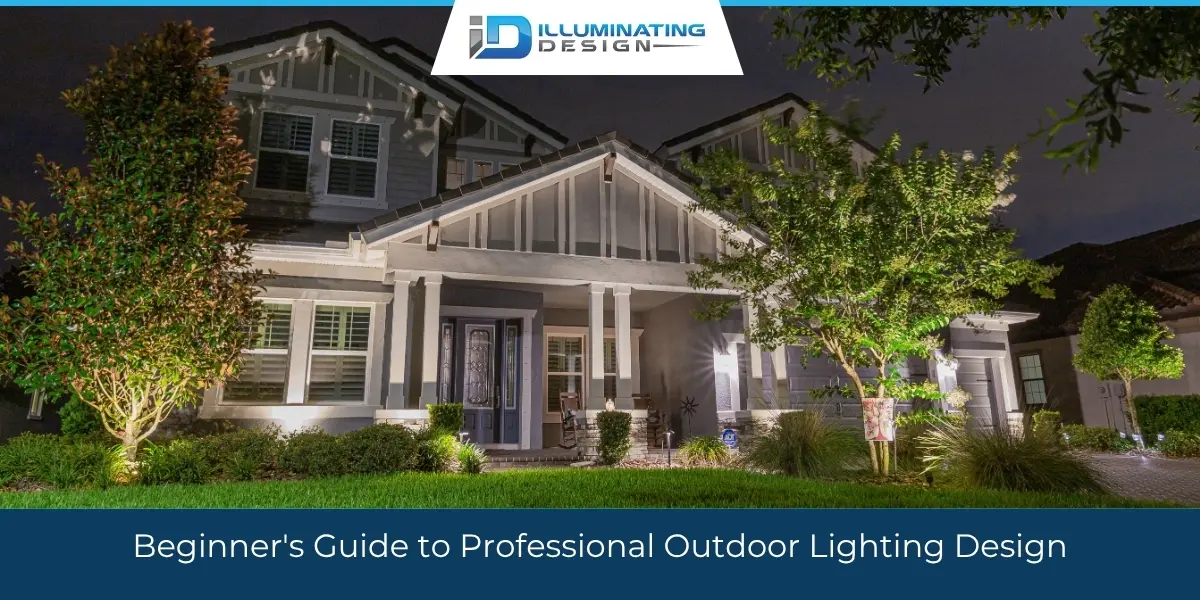
Why does professional outdoor lighting design change the way a property feels after dark?
Because it does more than add light - it shapes safety, security, and beauty with intention. To get lasting results, you need a professional plan for fixture selection, placement, and techniques like uplighting, path lighting, and layered illumination. At Illuminating Design, that strategic approach turns outdoor spaces into a cohesive, welcoming nighttime environment.
If you manage multiple properties, here's what professional outdoor lighting delivers:
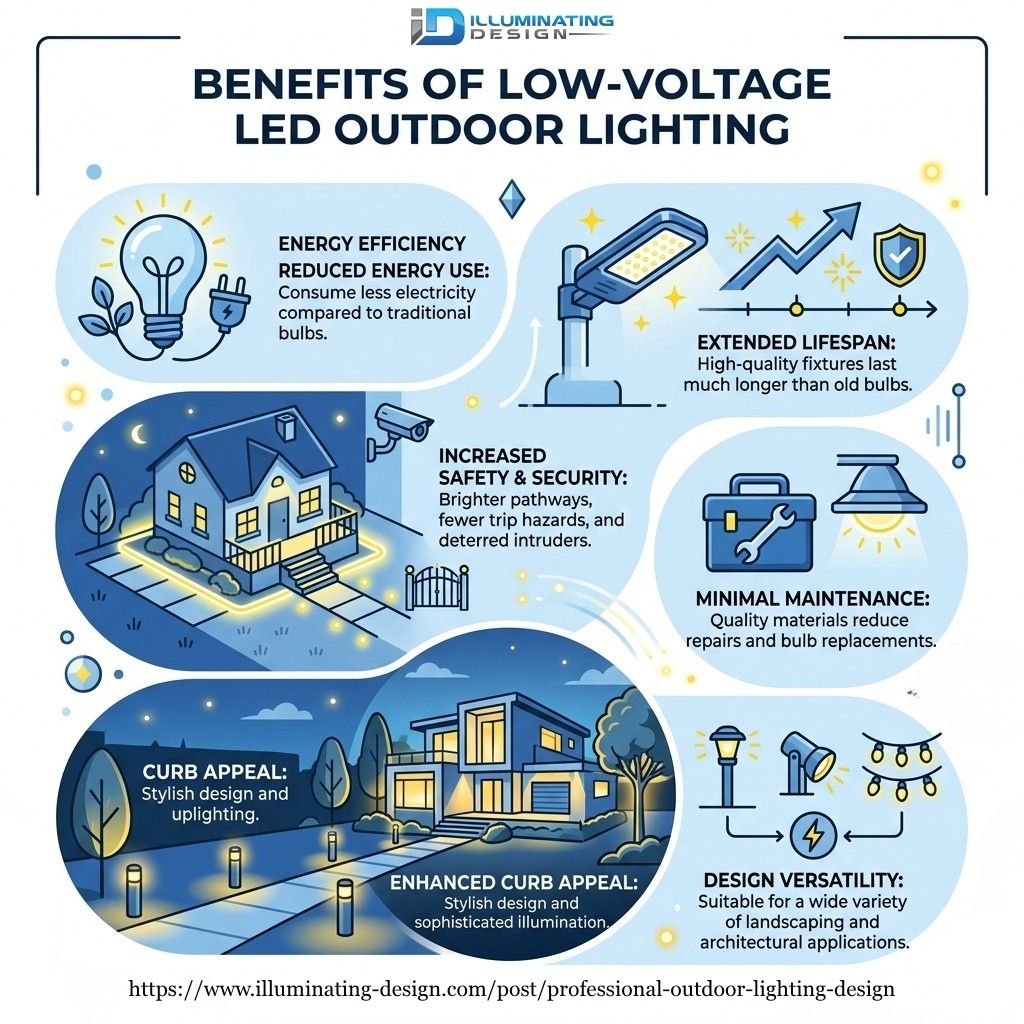
- Safety - Illuminated walkways, stairs, and driveways reduce trip hazards and liability
- Security - Well-lit perimeters and entryways deter unauthorized access
- Curb appeal - Architectural and landscape lighting makes properties stand out at night
- Energy efficiency - LED systems use up to 80% less electricity than traditional bulbs, according to the U.S. Department of Energy
- Low maintenance - Quality fixtures and proper design reduce ongoing repair headaches
- Scalability - Professional systems are built to expand as your property needs change
For property managers and HOA leaders, inconsistent lighting across sites is one of the biggest pain points. Some areas feel over-lit and harsh. Others are dangerously dark. A professionally designed system solves both problems at once — with intention and precision, not guesswork.
The difference between a dark, neglected property and one that feels safe, polished, and welcoming at night often comes down to one thing: whether the lighting was designed or just installed.
This guide walks you through everything — from core design principles and fixture selection to technical specs, the installation process, and long-term maintenance.
The Core Principles of Professional Outdoor Lighting Design
At its heart, professional outdoor lighting design is about more than just "buying some lights." It is a specialized discipline that treats your property as a 3D canvas. We don't just aim to eliminate darkness; we aim to create clarity, balance, and intention. This involves understanding how light interacts with different materials—like the rough texture of a stacked stone wall versus the smooth surface of a glass entryway.
One of the first things we consider is the "what" and "why." Are we highlighting a majestic oak tree, or are we ensuring a guest can safely navigate a winding stone path? By identifying these unique ways to light up the exterior of your property, we can select the right tools for the job.
Choosing the Right Materials and Technology
The "bones" of your system matter. In the humid and sometimes stormy climate of metro Atlanta, materials like solid brass and heavy-duty copper far outlast the cheap plastic or thin aluminum found at big-box retailers. These professional-grade materials develop a beautiful patina over time and withstand the elements without corroding.
Furthermore, the shift to LED technology has revolutionized the industry. Modern LED systems are not just about saving money; they offer incredible control over color temperature and beam spread.
FeatureHalogen BulbsLED SystemsEnergy ConsumptionHigh (50W+ per fixture)Low (5W-7W per fixture)Lifespan2,000 - 5,000 hours30,000 - 50,000 hoursHeat OutputVery High (Fire risk in mulch)Very Low (Cool to the touch)Color ControlLimitedHigh (Warm to Cool options)MaintenanceFrequent bulb changesMinimal
By utilizing our professional lighting services, you ensure that your system is built on a foundation of energy efficiency and durability.
Essential Techniques for Professional Outdoor Lighting Design
To achieve a high-end look, we utilize a variety of specialized techniques. It isn't just about sticking a light in the ground; it’s about where the light goes and what it does.
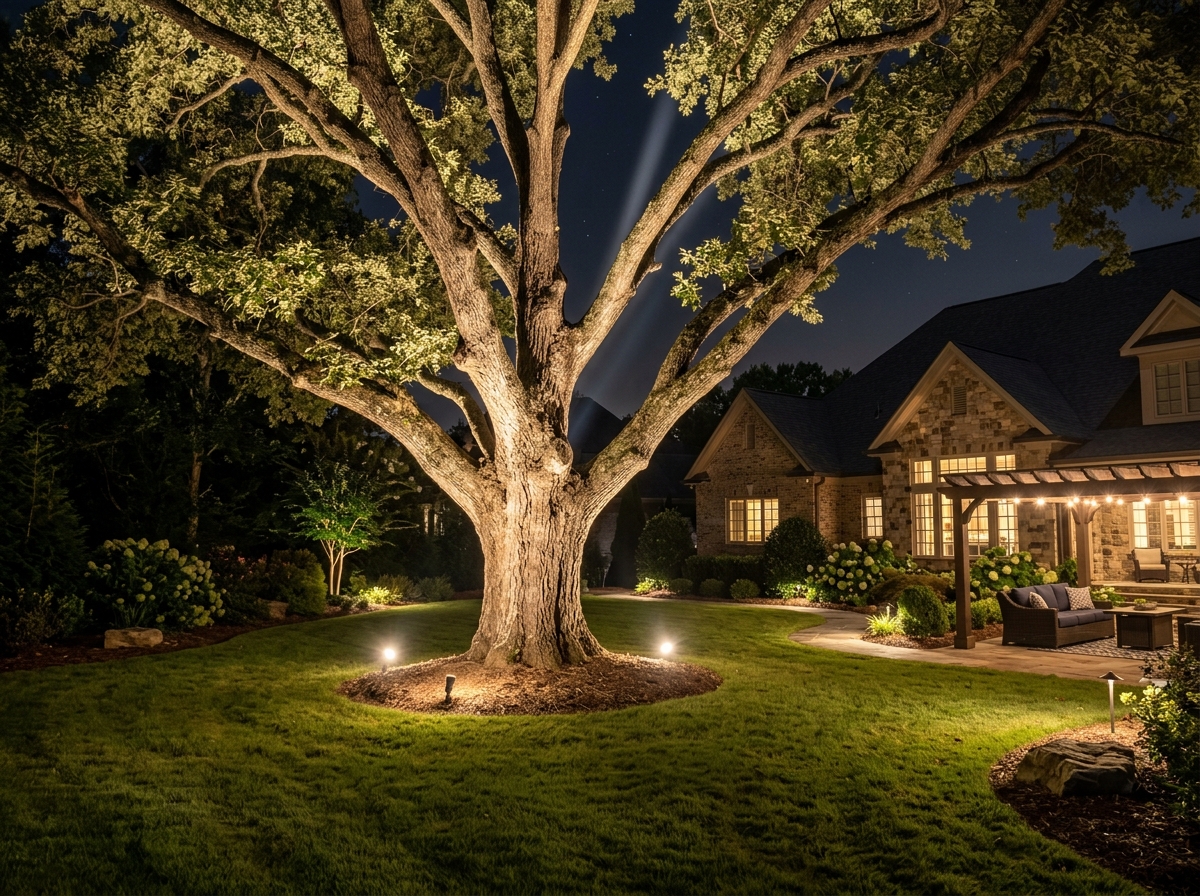
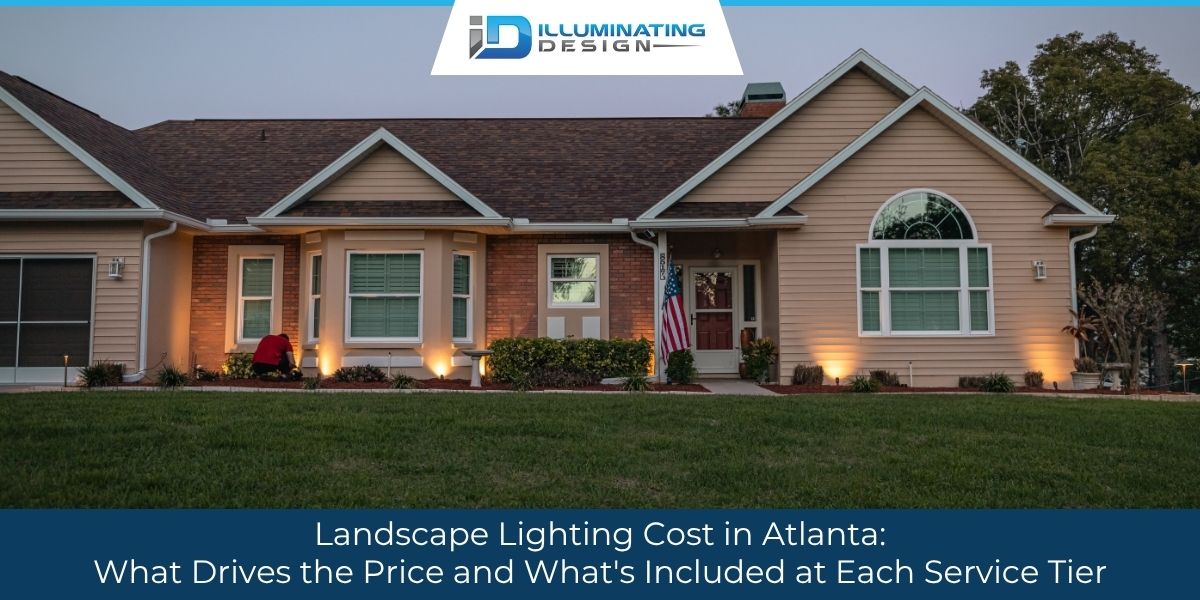
- Uplighting: This is the bread and butter of landscape lighting. By placing fixtures at the base of trees or architectural columns and aiming upward, we create drama and emphasize height.
- Downlighting (Moonlighting): We mount fixtures high in trees or under eaves to cast a soft, natural glow downward. This mimics the effect of moonlight, creating beautiful shadows on the ground.
- Path Lighting: We space these fixtures 8 to 10 feet apart to create overlapping pools of light. This ensures safe navigation without making your driveway look like an airport runway.
- Hardscape Lighting: These are "hidden" fixtures tucked under stair treads, stone caps, or outdoor kitchen counters. They provide safety and highlight the textures of man-made structures.
- Wall Washing and Grazing: Wall washing provides a smooth, even glow over a large surface. Grazing involves placing the light close to a textured wall to highlight the shadows and "nooks" in the stone or brick.
- Silhouetting: By lighting a plain wall behind a uniquely shaped plant or statue, we create a dark, dramatic silhouette that draws the eye.
Why Professional Outdoor Lighting Design Outperforms DIY
It is tempting to think that a weekend trip to a hardware store and a few solar stakes are enough. However, there is a massive gap between a DIY project and professional outdoor lighting design.
The most common DIY mistakes include:
- "The Runway Effect": Placing path lights in a straight, perfectly even line, which looks unnatural and clinical.
- Glare Issues: Aiming lights so they hit people in the eyes rather than illuminating the target.
- Under-powering: Using a transformer that can't handle the load, leading to dim lights at the end of the line.
- Poor Connections: Using "pinch" connectors that eventually corrode and fail in the Georgia red clay.
Why professional lighting products outshine DIY options comes down to the quality of the components. Professional systems use integrated LEDs, which are engineered to dissipate heat effectively, ensuring the light lasts for decades. We also focus on "hiding the source"—you should see the light, not the fixture.
Layered Lighting for Depth and Drama
Think of your outdoor space like a theater stage. If you turn on one giant floodlight, everything looks flat and washed out. If you use layers, you create a masterpiece.
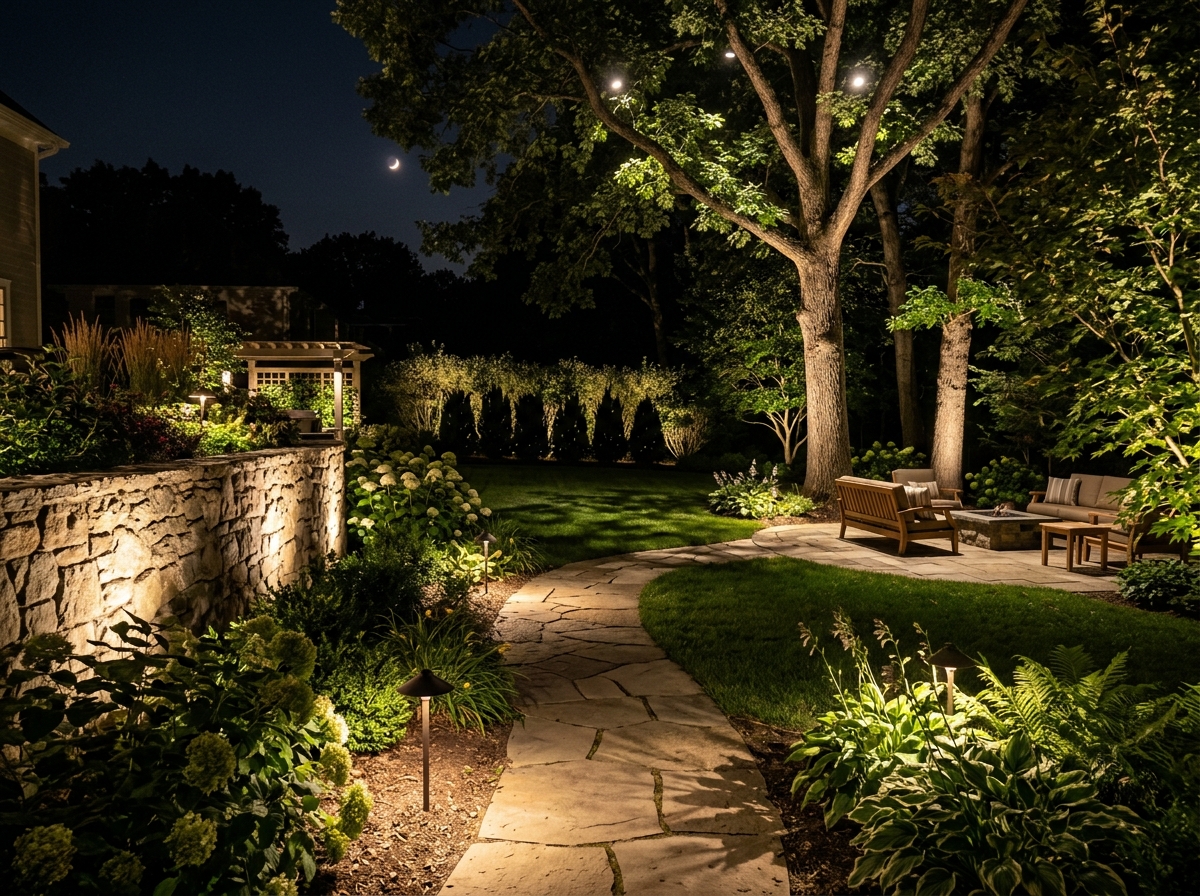
We achieve this through a "visual hierarchy." We pick a focal point—perhaps a large Japanese Maple or a stone fireplace—and give it the most "visual weight" with brighter light. Then, we add mid-level ambient light for the surrounding area and low-level accent light for the perimeter.
This requires restraint. A common mistake is over-lighting. Professional designers know that what you leave in the shadows is just as important as what you illuminate. By evaluating sightlines from both inside the house and from the street, we ensure the composition looks balanced from every angle. We also carefully select color temperatures (usually a warm 2700K to 3000K) to ensure the property feels welcoming, not like a parking lot.
Technical Precision: Voltage Drop and Load Calculation
This is where the "art" meets the "science." To ensure every light on your property shines with the same intensity, we have to do some math.
When electricity travels down a long wire, it loses "pressure"—this is called voltage drop. If the wire is too thin or the run is too long, the lights furthest from the transformer will look dim and yellow. As experts in design and service in Atlanta, we calculate the "load size" (total wattage) and use the proper cable gauge (usually 12-gauge or 10-gauge) to prevent this.
- Transformer Sizing: We typically recommend a transformer that has 20-30% more capacity than your current lights need. This allows for scalability, so if you add a new garden bed next year, we can easily add more lights without replacing the whole "brain" of the system.
- Smart Controls: We can integrate your system with astronomical timers that automatically adjust for the changing sunset times in Alpharetta or Roswell, or even connect them to your smartphone for custom dimming and zoning.
The Step-by-Step Design and Installation Process
When you work with us, we follow a proven 6-step process to ensure your vision comes to life perfectly.
- Consultation: We walk your property with you in the daytime to understand how you use the space.
- Site Analysis & Rendering: We take photos and create free design renderings so you can see exactly what the lights will look like before a single wire is buried.
- Conceptual Sketching: We map out the electrical runs, fixture placements, and transformer locations to ensure our services are efficient.
- Professional Installation: Our team buries cables 3-6 inches deep, mounts transformers near GFCI outlets, and uses waterproof connectors to ensure longevity.
- Night Aiming: This is the most important step! We return after dark to "fine-tune" the angles. A half-inch adjustment of a spotlight can be the difference between a glare in your window and a perfectly lit tree canopy.
- Maintenance Setup: We ensure the system is code-compliant and set up your ongoing care plan.
Investment and Real-World Results
While the initial cost of a professional system is higher than DIY, the return on investment is significant. You are not just buying bulbs; you are transforming your property with professional lighting.
- Property Value: A well-lit home has significantly more "curb appeal," which is a major factor in resale value in competitive markets like Buckhead or Sandy Springs.
- Energy Savings: By converting old halogen systems to LED, many of our clients see their lighting energy usage drop by up to 80%.
- Safety & Liability: For commercial properties or HOAs in Peachtree Corners, proper lighting reduces the risk of accidents and deters crime, potentially lowering insurance premiums.
Whether it’s a residential backyard in Dunwoody or a large commercial estate in Milton, the results are always the same: a property that is safer, more beautiful, and usable 24 hours a day.
Long-Term Performance and Maintenance
Outdoor lighting lives in a harsh environment. In the metro Atlanta area, our systems have to deal with falling branches, curious squirrels, heavy rain, and the occasional ice storm. Even the best-designed system needs a little love to stay perfect.
This is why we offer worry-free annual maintenance programs. We don't just wait for a light to go out; we proactively check for:
- Fixture Realignment: As trees grow and soil shifts, fixtures can get "tilted." We straighten them out.
- Lens Cleaning: Hard water and dirt can cloud the glass, reducing light output.
- Pruning: We trim back any new growth that might be blocking a light's path.
- System Testing: We check the transformer and voltage levels to ensure everything is running at peak efficiency.
At Illuminating Design, we bring over 20 years of expertise to every project. From holiday light design to permanent architectural masterpieces, we are dedicated to making your Georgia property shine.
Ready to see your home in a new light? Schedule your free design rendering today. Whether you are in Johns Creek, Brookhaven, or anywhere in the metro Atlanta area, we are here to help you own the night.


Bringing Your Vision to Light
Projects Completed
Our team has successfully completed over 3,000 installations, ensuring each project is tailored to meet the client's unique needs.
Years of Experience
With over 20 years in the industry, our expertise and commitment to quality shine through in every project we undertake.
Lights Installed
We have illuminated spaces with over 10,000,000 lights, bringing creativity and innovation to every design.




.avif)





Transform Your Space with Custom Lighting