
Watt's Up? The Best Landscape Lighting for a Brilliant Backyard
Why Landscape Lighting Transforms Your Property Day and Night

Why does landscape lighting make such a dramatic difference? Because it instantly boosts beauty, safety, and nighttime curb appeal - and if you want your property to truly shine after dark, you need the right plan. Illuminating Design helps turn that potential into a brilliant outdoor experience.
Quick answer: What is landscape lighting used for?
- Safety - illuminates paths, steps, and driveways to prevent accidents
- Security - deters intruders by eliminating dark hiding spots
- Curb appeal - highlights architectural features and landscaping after dark
- Outdoor living - extends usable hours on patios, decks, and gardens
- Property value - well-designed lighting systems increase perceived and actual home value
For property managers and HOA leaders, the stakes are even higher. Inconsistent lighting across multiple sites creates safety liabilities, complaints from residents, and constant maintenance headaches.
The good news? Modern outdoor lighting has come a long way. Today's LED systems consume up to 90% less energy than conventional bulbs and can last up to 50,000 hours. That means fewer replacements, lower energy bills, and less time managing maintenance calls.
Whether you're lighting a single entryway or coordinating fixtures across an entire community, the right setup makes a real difference — in how a property looks, feels, and functions at night.
This guide breaks down the best landscape lighting options available today, so you can make smart, confident decisions for every site you manage.
Essential Types of Landscape Lighting Fixtures
Choosing the right hardware is the first step toward a brilliant backyard. In landscape lighting, there isn't a "one size fits all" fixture. Each light is engineered for a specific purpose, from broad illumination to surgical precision.
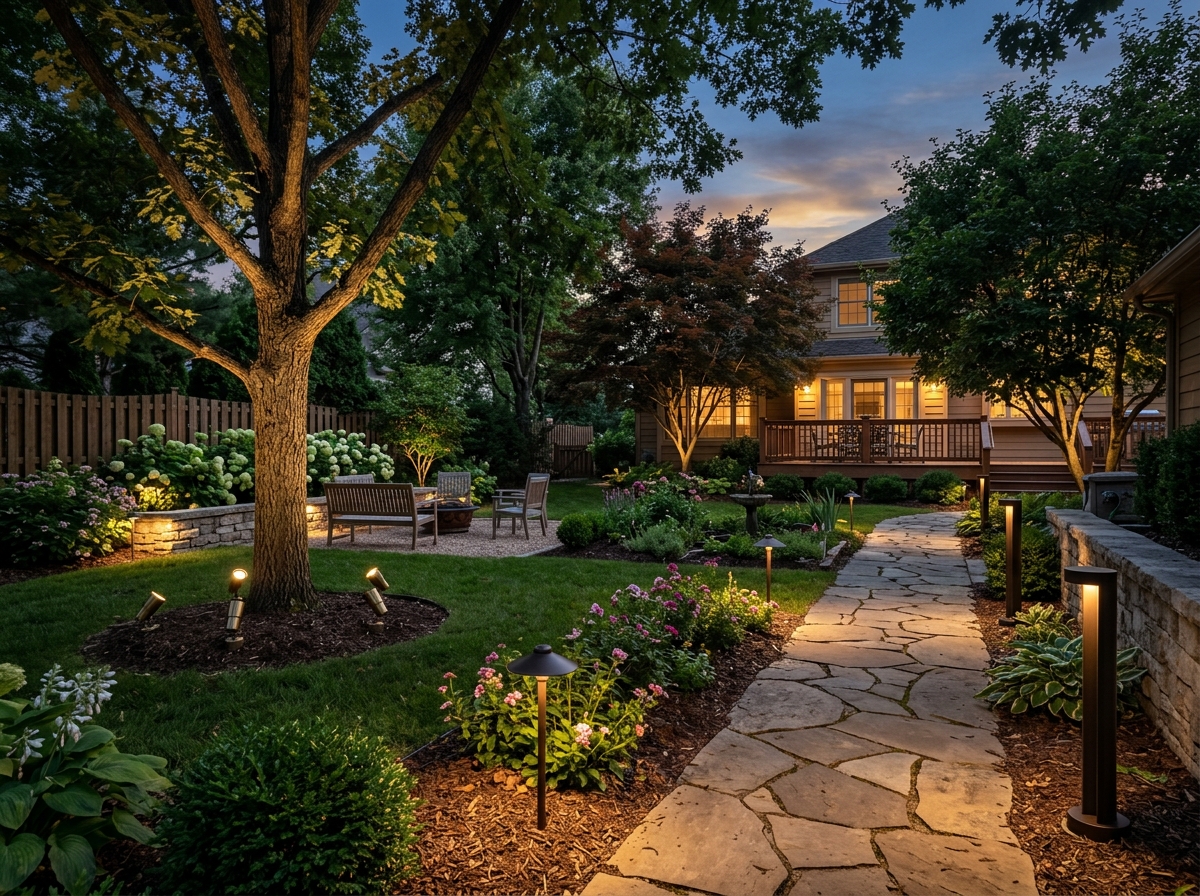
The Heavy Hitters: Spotlights and Floodlights
Spotlights are the snipers of the lighting world. They provide a narrow, intense beam (usually around 45 degrees) designed to highlight a specific focal point, like a statue or a prize-winning Japanese Maple. Floodlights, on the other hand, provide a wide wash of light (up to 120 degrees) to illuminate large areas like driveways or expansive garden beds.
Guiding the Way: Path and Bollard Lights
Path lights are essential for safety. These fixtures typically stand about 14 inches high and are positioned along walkways to cast light downward. Bollard lights are a sturdier, often more architectural version of path lights, frequently seen in commercial settings or along modern driveways in North Atlanta.
Hidden Heroes: Well, Hardscape, and Step Lights
Well lights (or in-ground lights) are buried flush with the ground, making them perfect for uplighting trees where you don't want to see the fixture itself. Hardscape lights are slim LEDs tucked under stone ledges or fire pit caps, while step lights ensure that no one takes a tumble on your deck or patio stairs.
Specialized Fixtures: Deck and Underwater Lights
To round out a professional setup, deck lights are surface-mounted to posts to create a cozy perimeter glow. If your property features a pond or fountain, underwater lights add a magical, shimmering effect that transforms water features into nighttime masterpieces.
| Fixture Type | Beam Width | Primary Use |
|---|---|---|
| Spotlight | Narrow (45°) | Highlighting focal points/trees |
| Floodlight | Wide (Up to 120°) | Wall washing/large area safety |
| Path Light | Downward Spread | Walkway safety and aesthetics |
| Well Light | Upward Vertical | Uplighting without visible hardware |
Choosing the Right Landscape Lighting for Your Property
Designing a layout is about more than just sticking lights in the dirt; it’s about creating an experience. We use various techniques to bring a property to life.
- Uplighting: Placing a light at the base of a tree or architectural column to draw the eye upward.
- Silhouetting: Placing a light behind an object to create a dark shape against a glowing backdrop.
- Moonlighting: Placing lights high in trees (like our local Georgia oaks) and aiming them down through the branches to mimic natural moonlight.
- Grazing: Positioning a light close to a textured surface, like a stacked stone wall, to emphasize shadows and depth.
- Washing: Flooding a large, flat surface with light to create a soft, even glow.
When planning your layout, it is helpful to consult a Landscape Lighting Guide to understand the technical basics, or explore Unique Ways to Light Up the Exterior of Your Property for creative inspiration tailored to the Atlanta area.
The Technical Side: Lumens, Voltage, and LED Efficiency
If you want a system that lasts longer than a single season, you need to understand the "guts" of the operation. Modern landscape lighting has largely moved away from high-voltage (120V) systems in favor of low voltage (12V) setups.
Why Low Voltage?Low voltage systems are significantly safer for DIYers and pets because the current is stepped down by a transformer. They are also easier to install since cables only need to be buried a few inches deep, rather than in deep, expensive conduits.
The Power of LEDLED technology has revolutionized the industry. Not only do LEDs use up to 90% less energy, but they also offer incredible control over color temperature. For a welcoming, classic look, we recommend warm white (2700K–3000K). This range mimics the cozy glow of traditional incandescent bulbs without the massive energy bill. Cooler tones (4000K+) are generally reserved for security or ultra-modern commercial aesthetics.
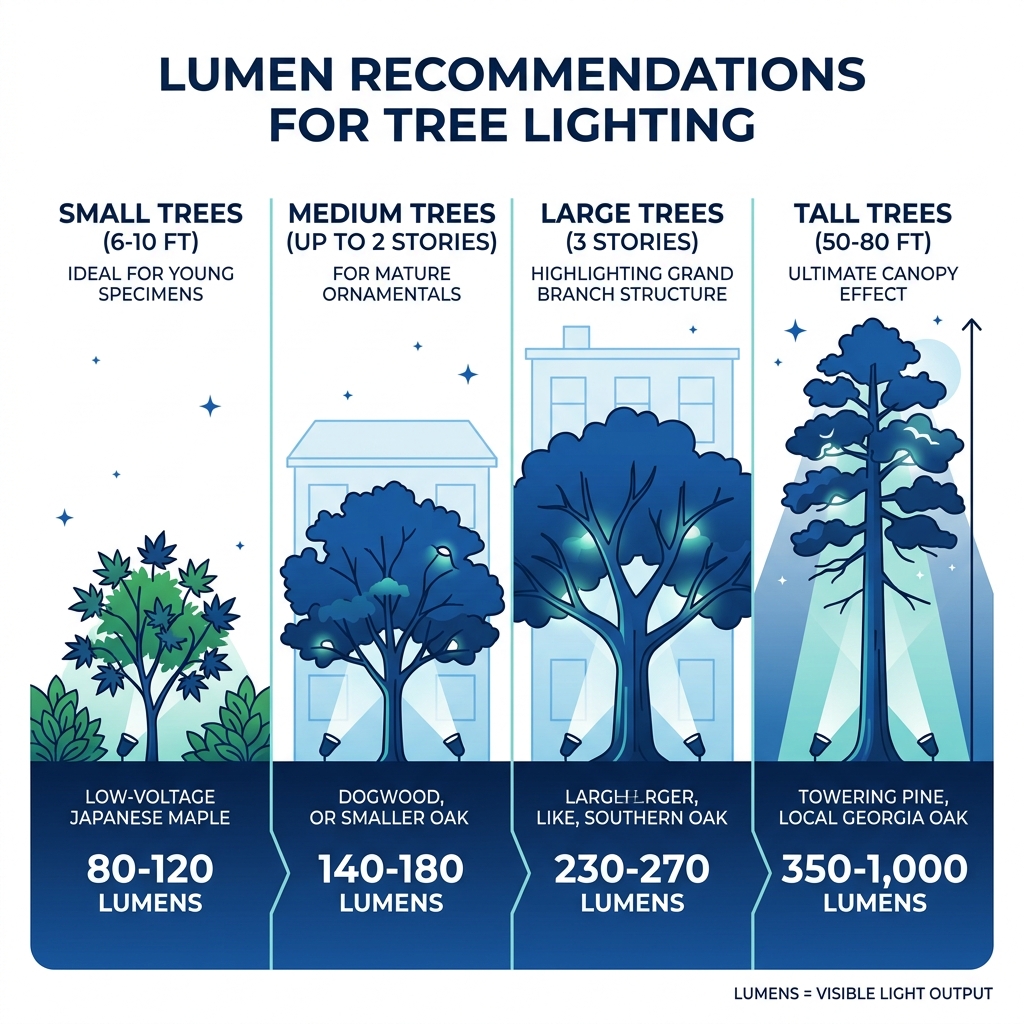
Lumen Guidelines"Lumens" measure the total amount of visible light. Using too many can cause "light pollution," while too few will leave your yard in the dark. According to industry standards found in Dark Sky:
- Small Trees (6-10 ft): 80–120 lumens
- Medium Trees (up to 2 stories): 140–180 lumens
- Large Trees (3 stories): 230–270 lumens
- Tall Trees (50-80 ft): 350–1,000 lumens
Designing and Installing Your Perfect Outdoor Setup
A brilliant backyard starts with a plan. One of the most common mistakes we see in Atlanta is "over-lighting." When you flood every corner of the yard with light, you lose the drama. The goal is to see the effect of the light, not the source.

Layout Planning and Light Layering
Think of your yard like a theater stage. You need a background, a middle ground, and a foreground.
- Foreground: Path lights and step lights for safety.
- Middle Ground: Spotlights on shrubs or garden features.
- Background: Uplighting on large trees or the home’s facade.
This "layering" creates depth and prevents the yard from looking flat. For those looking for professional help in the metro Atlanta area, you can find More info about landscape lighting services to see how we handle complex layouts.
Technical Essentials: Transformers and Wiring
Your landscape lighting system is only as strong as its weakest link.
- Transformer Sizing: To find the right size, add up the total wattage of all your bulbs and add a 20% "cushion." If your total is 80 watts, a 100-watt transformer is perfect.
- Wire Gauge: For most residential runs, 12-gauge or 14-gauge wire is the standard. Thicker wire (lower gauge number) is needed for longer runs to prevent "voltage drop," where the lights at the end of the line appear dimmer than the ones at the beginning.
- Waterproof Connectors: Never use standard electrical tape. Outdoor lighting requires gel-filled, waterproof connectors to prevent corrosion from Georgia's humidity and rain.
Professional vs. DIY Landscape Lighting Installation
Is this a weekend project, or should you call in the pros?
The DIY RouteYou can certainly purchase lighting kits from big-box stores. These are great for small, simple areas. They usually include a few fixtures, a small transformer, and some light-duty wire. However, these kits often lack the durability of professional-grade brass or copper fixtures and may only offer limited warranties.
The Professional AdvantageWhen we handle an installation at Illuminating Design, we bring 20+ years of expertise to the table. Professional systems offer:
- Lifetime Warranties: High-quality brass fixtures that won't rust or corrode.
- Workmanship Guarantees: Peace of mind that the wiring is buried correctly and the transformer is balanced.
- Maintenance Plans: We offer worry-free annual maintenance programs to clean lenses, trim overgrown foliage around fixtures, and replace any aging components.
- Design Renderings: We provide free design renderings so you can see exactly how your Brookhaven or Buckhead home will look before a single hole is dug.
If you're on the fence, we recommend starting with a Free Consultation to discuss your vision and budget.
Enhancing Security and Safety with Strategic Placement
While we love the beauty of landscape lighting, its functional benefits for safety and security are undeniable. A well-lit home is a less attractive target for intruders.
- Timers and Photocells: Use a photocell to turn lights on at dusk and a timer to turn them off at a set time (like 2:00 AM) to save energy.
- Smart Controls: Modern systems can be controlled via smartphone apps, allowing you to dim the lights for a dinner party or brighten them if you hear a bump in the night.
- Dark Sky Compliance: We focus on "Dark Sky" friendly designs, which use shielded fixtures to point light downward. This reduces light pollution and ensures you can still see the stars while keeping your driveway safe.
- Entryway Lighting: Illuminating the front door and garage area not only looks great but ensures guests can navigate safely to your entrance.
You can see examples of these functional yet beautiful setups in our gallery of Projects.

Conclusion: Illuminating Your Vision
Your outdoor space shouldn't disappear when the sun goes down. With the right landscape lighting strategy, you can transform your backyard into a brilliant oasis that provides safety, security, and endless evening enjoyment.
At Illuminating Design, we’ve spent over two decades perfecting the art of outdoor illumination across Atlanta, Alpharetta, Sandy Springs, and the entire metro area. From our free design renderings to our worry-free maintenance plans, our goal is to provide you with a system that you never have to worry about.
Whether you want to highlight a stately oak tree in Milton or secure a commercial property in Dunwoody, we have the expertise to make it happen.
Ready to see your property in a new light? Contact us for a brilliant backyard and let’s start designing your dream outdoor space today.

Bringing Your Vision to Light
Projects Completed
Our team has successfully completed over 3,000 installations, ensuring each project is tailored to meet the client's unique needs.
Years of Experience
With over 20 years in the industry, our expertise and commitment to quality shine through in every project we undertake.
Lights Installed
We have illuminated spaces with over 10,000,000 lights, bringing creativity and innovation to every design.






.avif)